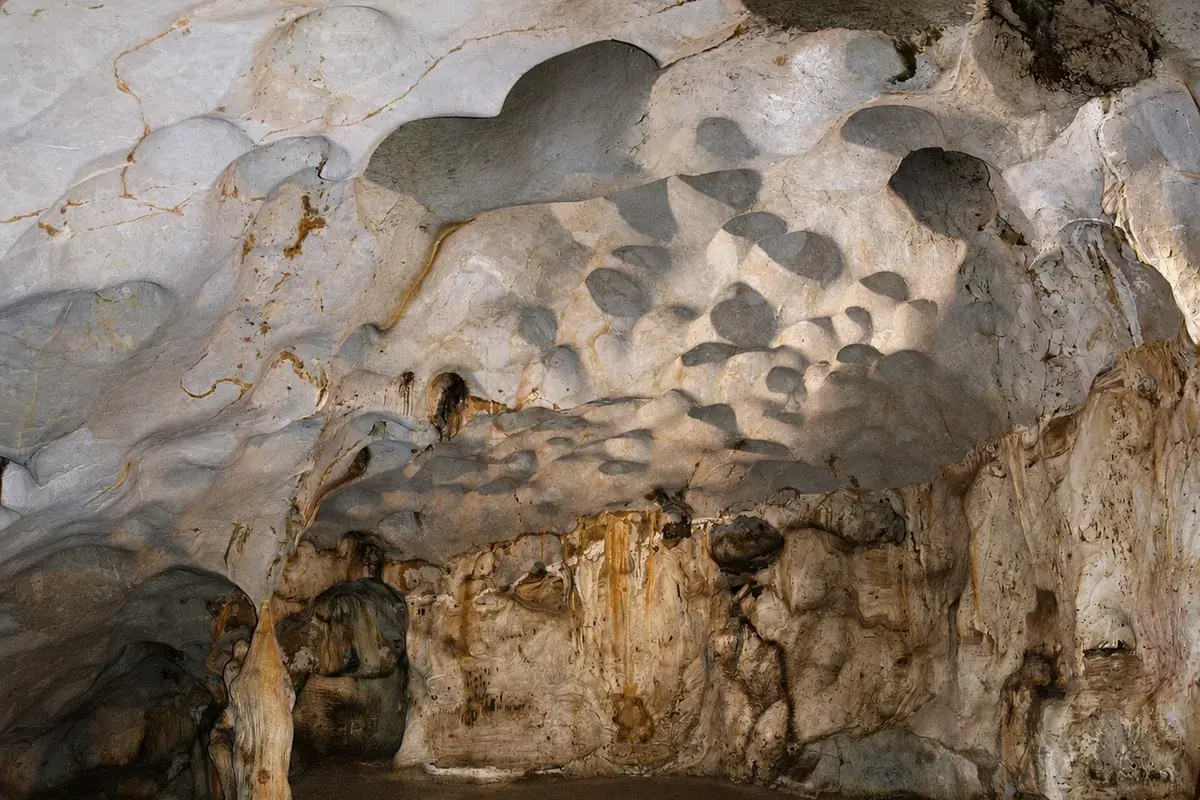
Why Karain is worth the climb
The Ministry of Culture and Tourism traces Karain's earliest evidence to hunter-gatherers making simple tools 500,000 years ago, followed by an uninterrupted Lower, Middle and Upper Paleolithic sequence. Having these periods at one location allows researchers to compare changes in technology, fauna and climate within the same stratigraphic record. The setting helps explain the repeated occupation: the cave offered shelter and a raised outlook, while springs where the mountains meet the plain and the land below supported the people who used it.
Start with the base museum
The Karain Museum beside the parking area is a small finds display, principally animal bones and teeth, rather than a sequence of period galleries. Twenty minutes here gives useful context for the excavation faces upstairs. The ministry says that other Karain finds, including stone and bone tools, beads and portable art, are divided between this museum and the Antalya Archaeological Museum. The latter is closed, so it cannot presently be added as a same-day continuation.
A workable visit allows 20 minutes at the base, 15–20 minutes for the ascent, 30–40 minutes in the chambers and 10–15 minutes for the descent. With terrace stops, that comes to about 90 minutes. Allow two hours to read every panel and photograph the interior. Driving time and any second archaeological site are additional.
Tickets and opening hours
Admission and museum passes
There is one standard site admission, managed by the Turkish Ministry of Culture and Tourism, and prices are published in euros. Foreign admission is ≈ $5.5 (€5) under the DÖSİMM museum and archaeological-site fee schedule. Turkish citizens may enter with Müzekart, as stated on the ministry's Karain visitor page.
| Option | Official price and validity | When it makes sense |
|---|---|---|
| Turkish citizens | Entry with Müzekart, according to the Ministry of Culture and Tourism's Karain page | Residents and citizens who already use the national museum card |
| MuseumPass The Mediterranean | ≈ $99 (€90); valid for 7 days from the first museum visit | A broader itinerary covering participating sites in Antalya, Mersin, Adana and Denizli |
| MuseumPass Türkiye | ≈ $180 (€165); valid for 15 days from the first museum visit | A nationwide trip with many ministry-run museums and archaeological sites |
Both passes allow one entry to each participating museum or site. Karain alone does not justify either card. Even a short Antalya itinerary combining Karain, Termessos and Perge remains well below the regional pass price at current individual tariffs. The Mediterranean pass becomes more plausible only when the trip extends across several provinces or includes a much longer list of participating attractions. For a simple Karain-and-Termessos day, ordinary admission is the cheaper choice.
Buy admission at the ticket office beside the parking area before going uphill. There is no second ticket desk at the cave mouth. Pass holders should also stop at the base to have their card processed.
Seasonal hours and when to go
Hours change by season. From 1 November to 1 May, Karain is open daily from 08:00 to 17:00 and the ticket office closes at 16:30, according to the Antalya Provincial Directorate's winter timetable. The longer-hours schedule on the ministry's Karain page is 08:00–19:00, with ticket sales until 18:30. Both schedules operate every day.
Visitors describe the exposed climb as most tiring in warm weather, particularly with children, and the cave as refreshingly cool afterward. Opening time is therefore the practical summer choice; benches on the bends provide places to pause. In winter, the 16:30 ticket cutoff makes an early-afternoon arrival preferable for the full museum-and-cave visit. Morning light also shows the pattern of fields clearly from the upper terrace.
Getting there, and when a tour helps
Karain is about 30 km northwest of central Antalya by road, measured to the site parking area, and the drive takes 40–50 minutes depending on the starting point and traffic. The usual approach follows the D650 toward Burdur before turning onto the signed local road and Karain Caddesi.
No direct municipal bus delivers visitors to the ticket office. Getting off a bus in the wider Döşemealtı area leaves a rural onward journey, so a taxi should be arranged with waiting time and a return fare agreed in advance. A tour is most useful for travelers without a car or those who want the Paleolithic layers explained in detail. Guided itineraries often pair Karain with Termessos, producing a much more active day than the drive between them suggests.
Practical visit: stairs, chambers and facilities
Museum → staircase → terrace → three chambers
- Begin at the museum and toilets beside the parking area, then follow the marked stone staircase. Approximately 450 steps lead to the cave; there is no lift, step-free alternative or vehicle route to the entrance.
- The lower zigzags are comparatively gentle. The sustained flights come higher up, where the steps are less regular and the slope more exposed. Use the benches and wider landings for rests without blocking the path.
- At the top, the broad terrace faces the Döşemealtı fields. Its outer edge, clear of the doorway, gives the widest view across the plain. Before entering, inspect the exterior rock immediately beside and above the entrance for carved niches and Greek votive inscriptions; they are outside, not in the inner chambers.
- From the entrance, the established route leads down into the main chamber, the broadest and most open of the three. Steps and narrower, winding passages continue to the second and third chambers. Watch your head where the rock lowers, and return by the same route.
The interior has no continuous level boardwalk. Expect worn stone, damp patches and changes in floor level. Stalactites, stalagmites and joined calcite columns are present, while excavation areas remain the principal features. A small handheld torch reveals uneven surfaces more effectively than a phone screen; stay on the established route and do not touch calcite or inscribed stone.
Clothing, bags and access
Wear trainers or hiking shoes with rubber soles that grip smooth limestone. Flip-flops and loose sandals are awkward on the descent, and rain makes the exterior steps slick. The cave interior stays around 16°C, so it feels cool after a summer climb; a light layer is sufficient for most visitors. Carry sun protection and, in summer, a litre of water per person, since there are no visitor services along the staircase or at the top.
Keep bags small enough to carry with both hands free. There are no lockers or supervised cloakrooms at the ticket office or cave entrance, so suitcases and large shopping bags should be left at accommodation or secured out of sight in a vehicle.
The stepped route and narrow interior passages rule out wheelchairs and strollers. A secure child carrier is the workable option for an infant, provided the adult is confident on stairs and comfortable ducking through lower sections. Visitors with knee problems should consider the descent as well as the climb. Older children need close supervision around damp rock and changes in floor level.
Toilets are at the base near the ticket office and museum; there are none along the staircase or inside the cave. There is no public Wi-Fi, and mobile reception is more dependable around the open parking area than within the chambers. Download tickets, maps and return-transport details before leaving central Antalya, and keep a prearranged driver's number available offline.
Photography
- A phone flash illuminates nearby dust and rock but does little for the far wall of a large chamber. Bracing the phone against a solid railing or using a night setting produces a steadier result without crossing barriers.
- Take exterior photographs before entering if the light is good. Cloud cover and the angle of the sun can change during the cave visit, and returning uphill for a missed view adds unnecessary climbing.
Location and what's nearby
Karain sits in a rural part of Döşemealtı at the western edge of the Taurus foothills. Fields, village roads and low-density development replace Antalya's coastal scenery. The district is also known for hand-woven carpets, but the immediate cave area is focused on the archaeological site rather than shopping. Distances below are approximate road distances from the Karain parking area; driving times allow for local roads but not a long stop for food or fuel.
| Place | Distance and drive from Karain parking area | How to combine it |
|---|---|---|
| Kırkgöz Han | About 5 km; roughly 10 minutes | A short architectural stop at a 13th-century Seljuk caravanserai, easy to add before lunch |
| Evdir Han | About 12 km; roughly 15–20 minutes | Another medieval roadside inn, useful for travelers specifically interested in Seljuk trade routes |
| Güver Kanyonu | About 25 km; roughly 30–40 minutes | A separate canyon viewpoint and nature outing, not a feature beside the cave |
| Termessos | About 40 km by road; allow 45–60 minutes | A mountaintop ancient city with its own substantial walking and climbing, best treated as the main afternoon activity |
Do not count on a full restaurant at the cave. The base is suitable for a brief drink and rest, while lunch is better planned in Döşemealtı or along the main road after leaving Yağca. Carry what you need for the visit itself, then choose lunch according to whether you are continuing toward Termessos or returning to Antalya.
A full day can start with Karain and its museum in the cool morning, followed by Kırkgöz Han while still in the immediate area. After lunch, continue to Termessos only if everyone is comfortable with another uneven archaeological walk. Güver Kanyonu fits better on a different outing or as an alternative to Termessos; adding every stop creates backtracking and leaves too little time at the cave.
History and archaeology: reading the layers
Karain's cultural deposit is about 11 meters deep, but the three visitor chambers do not represent three successive periods. Research has concentrated on Chamber E, also called Kökten Hall, and side Chamber B. Chamber E contains the long Lower and Middle Paleolithic sequence; Chamber B has provided later Upper Paleolithic, Epi-Paleolithic and post-Paleolithic evidence. This distribution is why the site cannot be read as a simple walk from an "early" hall to a "late" one.
The oldest excavated units in Chamber E belong to the Lower Paleolithic. Their assemblages include thick flakes retouched into scrapers, notched and denticulated pieces, and bifaces attributed to these early levels. Much of the work involved striking a core and then altering the resulting flake. In the Middle Paleolithic layers above, discoidal and Levallois prepared cores, side-scrapers and Mousterian points become important. Prepared-core flaking allowed the knapper to control the shape of a flake before detaching it, a clear technological change from the earlier toolkit.
Later deposits add bone implements, beads and small works of portable art. Human remains include a Neanderthal skull fragment, rare evidence for these early humans in the Mediterranean region. None of these objects should be expected in situ in the visitor chambers. The visible excavation face near the entrance preserves their context: superimposed sediments and changes in the deposit show where evidence came from, while the artifacts themselves have been removed for study and museum display.
Animal bones broaden that record. Rhinoceros, elephant and hippopotamus remains, none belonging to Anatolia's present fauna, help researchers reconstruct a very different environment. Other discoveries include animals associated with colder or more open landscapes. Together with shells and geological evidence, they indicate major changes in climate, vegetation and the plain below the cave over immense spans of time.
Systematic research began under Professor İsmail Kılıç Kökten of Ankara University in 1946, with further campaigns in subsequent decades. Later work involving Işın Yalçınkaya and international specialists refined understanding of the occupation layers. Excavation areas remain part of an archaeological research site. Removing stones or possible artifacts destroys the positional evidence on which their interpretation depends.
The cave's use changed again in antiquity. Votive inscriptions and niches on the exterior rock indicate religious activity during the Roman period, associated by the ministry with worship of a mountain goddess. These carvings belong to a much later chapter than the Paleolithic deposits inside. Karain's archaeological and natural importance has also placed it on UNESCO's World Heritage Tentative List.
Frequently asked questions
How can visitors reach Karain Cave from Antalya?
The site is located about 35 kilometers northwest of central Antalya and can be reached by car via the D650 toward Burdur. There is no direct municipal bus to the ticket office, so travelers without a car need to arrange a taxi with waiting time or book a tour.
Is Karain Cave accessible for visitors with limited mobility or strollers?
No, the site is not accessible for wheelchair users or strollers. Reaching the entrance requires climbing roughly 450 stone steps with no lifts or ramps, and the interior contains uneven and damp surfaces.
What facilities and amenities are available at the site?
Restrooms, parking, the ticket office, and a small museum are located at the base of the hill. There are no toilets, lockers, or public Wi-Fi along the staircase or inside the cave itself.
What archaeological finds have been uncovered at Karain Cave?
Excavations have uncovered stone and bone tools, beads, portable art, and a Neanderthal skull fragment. Researchers have also documented Roman votive inscriptions along with bones of rhinoceros, elephant, and hippopotamus.
More in Nature & Outdoors
-
 Nature & Outdoors
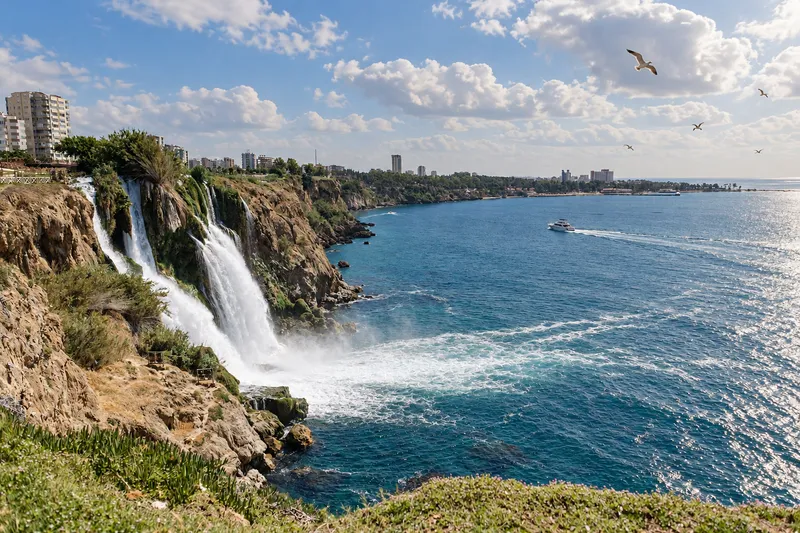
Düden Waterfalls
Plan your visit to Düden Waterfalls in Antalya. Check ticket prices, opening hours, cave access details, and tips to avoid crowds. Updated -
 Nature & Outdoors
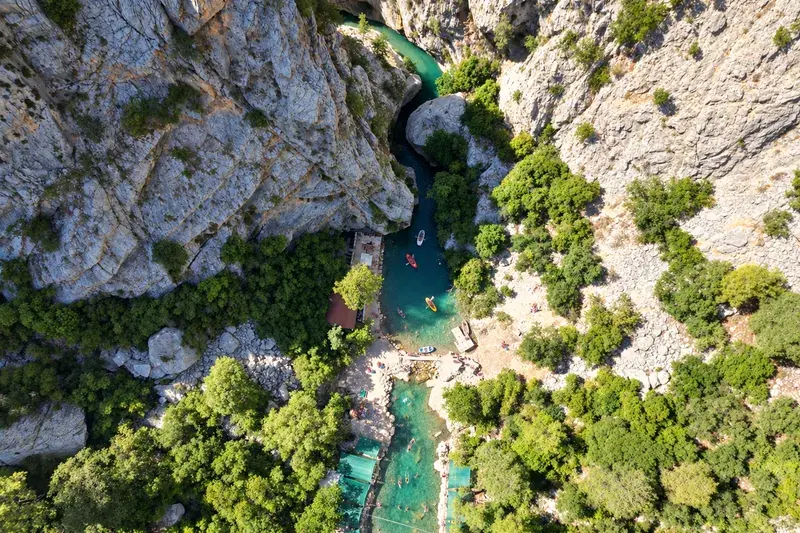
Göynük Canyon
Walk to the pools at Göynük Canyon, take the ≈ $33 (€30) boat or book the ≈ $27 (€25) Safari. Allow 30–40 minutes uphill and take KA07 from Antalya Otogar. Updated -
 Nature & Outdoors
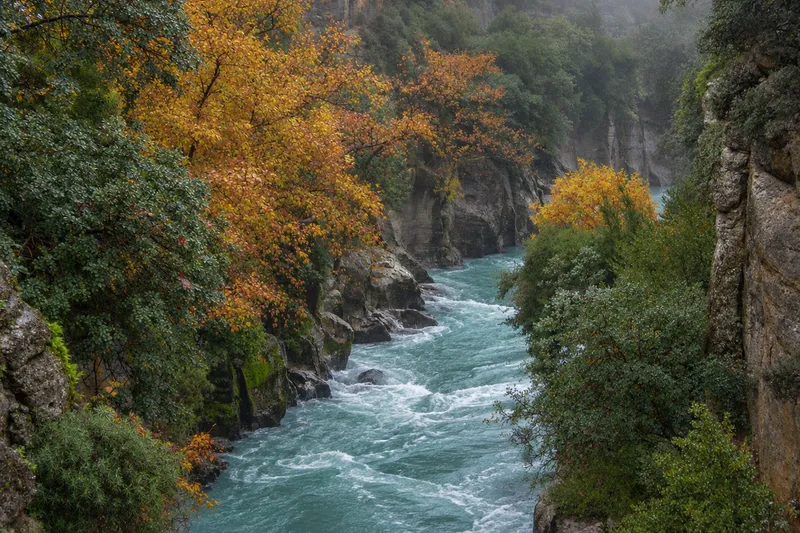
Köprülü Canyon
Köprülü Canyon is a full-day trip from Antalya: 14 km of rafting, Oluk Bridge and mountain drives to Selge and Tazı. Compare entry rules and transfers. Updated