Why visit
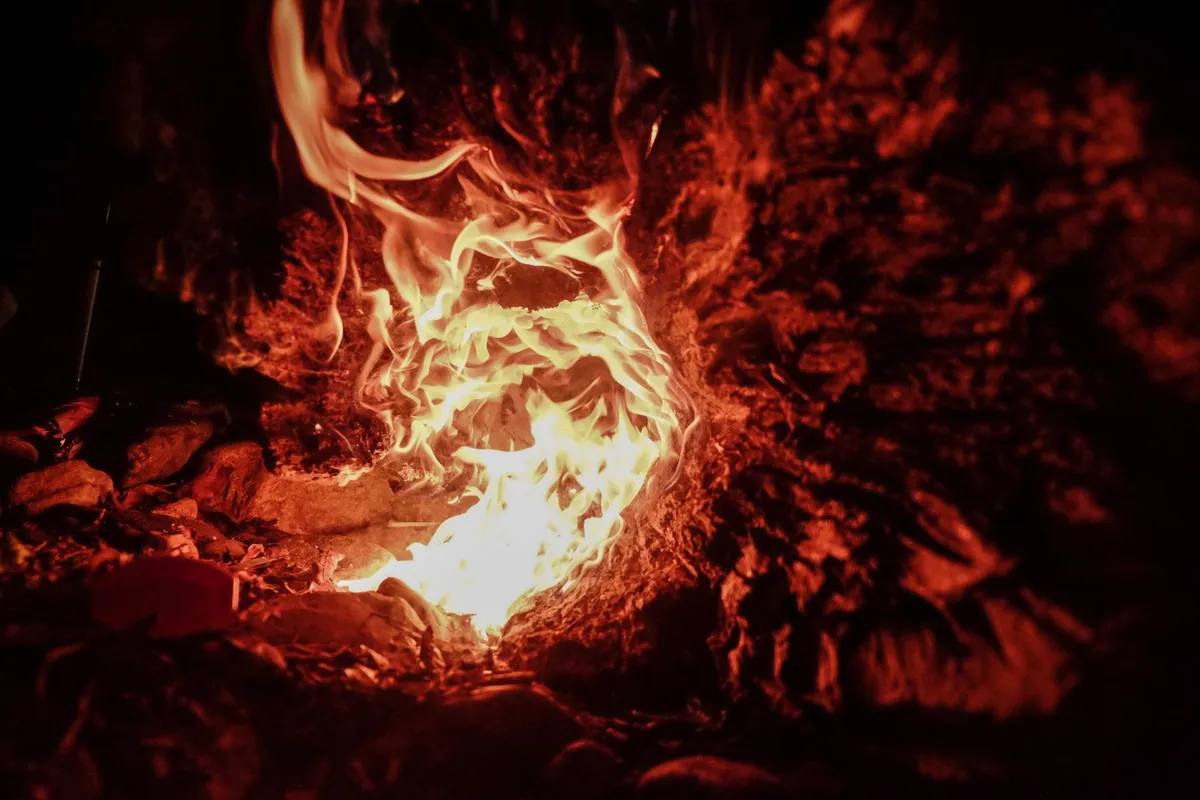
Active travelers, mythology enthusiasts, and anyone staying near Çıralı or Olympos should prioritize Yanartaş. The walk through pine forest ends at clusters of methane-fuelled flames flickering from the ground, a landscape closely associated with the Lycian legend of the Chimaera. Flame size varies from a few centimetres at smaller openings to stronger jets at larger vents.
Travellers report the same pattern: the flames can underwhelm in full daylight, then become much easier to distinguish as the rock darkens. Arriving before sunset also lets you examine the remains associated with the sanctuary of Hephaestus, which are difficult to pick out at night.
Skip the excursion if uneven steps, sustained uphill walking or descending rough ground in darkness will be unsafe for you. Visitors expecting a large volcanic crater may also be disappointed.
What to know beforehand
| Planning point | What to expect |
|---|---|
| Ticketed hours | Use the posted daily window of 09:00–21:00 for admission. Visitors already on the slope can finish at the vents and descend after dark, so an on-time evening visit may still end after 21:00. Older descriptions of unrestricted 24-hour access do not confirm that a new entry will be accepted after the booth closes. |
| Pedestrian admission | ≈ $1.9 (₺95) for Turkish citizens and ≈ $9.4 (₺475) for foreign visitors, according to the Ministry of Agriculture and Forestry pedestrian tariff. |
| Children and concessions | Under the DKMP protected-area implementation rules, children under seven and visitors over 65 enter free on foot. Students receive 50% off pedestrian entry with the relevant original identity document. |
| Time on site | Allow roughly two hours for the lower vents, a pause at dusk and the descent. Add extra time for the upper vents. |
| Payment | Tickets are sold at the booth at the trailhead. Carry a cash backup because unreliable mobile reception can interrupt card payments. |
Yanartaş is administered by DKMP as a protected natural area. It is absent from the official MuseumPass scheme, so MuseumPass Mediterranean, MuseumPass Turkey and Müzekart do not replace the separate entrance ticket.
Best time to visit
Start climbing about an hour before sunset. That leaves time for the ascent in natural light, a look around the lower vents and a short rest before the flames become prominent. In summer, this also avoids the hottest part of the day. Winter brings an earlier sunset and cooler stone, but rain makes the steps and polished rock more slippery. During July and August, arriving at the booth 75 minutes before sunset provides a useful 15-minute margin for the single ticket booth and base toilets.
| Month | Approximate sunset at Çıralı |
|---|---|
| January | 17:45–18:10 |
| February | 18:10–18:35 |
| March | 18:35–19:00 |
| April | 19:00–19:25 |
| May | 19:25–19:45 |
| June | 19:45–20:00 |
| July | 19:45–20:00 |
| August | 19:10–19:45 |
| September | 18:25–19:10 |
| October | 18:00–18:40 |
| November | 17:45–18:00 |
| December | 17:40–17:50 |
For photography, the blue hour immediately after sunset gives a useful balance: there is still enough ambient light to show the hillside, while the orange flame and its blue base remain visible. A small tripod helps with long exposures. After full darkness, photographs can isolate the flames nicely, although the surrounding landscape largely disappears.
Wind changes the experience considerably. Strong gusts flatten or scatter the flames, while heavy rain can extinguish smaller vents temporarily. Check the wind and rain forecast before setting out.
Tickets and tours
Buying at the entrance
One standard entry ticket, purchased at the small booth beside the trail, covers the marked visitor route and both the lower and upper flame areas. Save the tariff page offline before leaving Çıralı, and ask for a receipt if anything charged at the booth differs from the published rate. Keep that receipt: DKMP rules permit same-day re-entry without another pedestrian charge.
The Turkish-citizen tariff is also a useful reference when older tour listings show another price. Under the DKMP rules linked above, foreign pedestrian admission is set site by site at five to ten times the citizen rate; Yanartaş uses the five-times level.
When a tour makes sense
An evening tour is useful from Antalya city or Kemer if you do not have a car and must return the same night. Its main benefit is transport after dark; the path is straightforward and a guide is optional.
Denis Tour advertises a Kemer-region pickup at 16:00 and hotel return by 23:00, with Yanartaş admission and dinner at Botanic Restaurant included. Neba Travel lists round-trip Kemer transfers, Yanartaş admission, guiding and dinner, while drinks and Olympos Ancient City admission are extra. Both are broader Olympos–Ulupınar–Yanartaş excursions, so travelers who only need a ride to the flames should compare them with a local transfer.
Read the timing carefully. An itinerary allowing only 45 minutes at Yanartaş does not leave enough time to reach the main vents, see them and return. Some excursions also devote much of the evening to a trout-restaurant stop in Ulupınar; choose one of those only if that dinner is part of what you want.
From accommodation in Çıralı, an organized tour usually adds little. A local taxi, bicycle or your own vehicle gives you control over arrival and departure. Using the published Antalya taxi rates of ≈ $0.79 (₺40) to start and ≈ $0.99 (₺50) per kilometre, a central Çıralı–booth ride works out at roughly $4.3 (₺215) one way; two separately booked legs are about $8.5 (₺430) before waiting time. Ask for a total that includes the return and the time spent at the flames, or fix a later pickup point and time before starting the climb.
Getting there and finding the entrance
The entrance lies at the end of the road running north through Çıralı. Drivers follow the Yanartaş signs to the parking area and ticket booth. Beyond the booth, motor vehicles stop and the stone trail begins.
There is no numbered AntalyaKart city-bus route to the flames. From Antalya Intercity Bus Terminal, the practical public-transport option is a regional minibus bound for the Kumluca side. Batı Antalya Tur lists an Antalya–Çıralı Kavşağı service; tell the driver that you need the Çıralı junction. From there, continue by the local connection into Çıralı or a pickup arranged with your accommodation. The junction, village and trailhead are three separate stages of the journey.
| Leg | Distance and time | Practical detail |
|---|---|---|
| D400 Çıralı Kavşağı to Çıralı village | About 7 km | Arrange the local connection or accommodation pickup before boarding the regional bus in Antalya. |
| Çıralı bridge to the Yanartaş parking area and booth | About 3.5 km; roughly 10 minutes by car or 45–60 minutes on foot | The paved road continues north through the village, with Yanartaş signs toward the entrance. |
| Ticket booth to the lower flames | About 1 km; 30–40 minutes uphill and 20–30 minutes down | A sustained stone trail with irregular steps, gravel and polished rock. |
| Lower flames to the upper vents | Another 10–15 minutes uphill | Return by the same route. |
Public transport is a poor match for a same-night return after the flames. Services thin out in the evening, and the remaining walk from the village to the entrance adds another stage. Stay overnight in Çıralı, drive, or book a return transfer if the dusk visit is the purpose of the trip.
- Reach the parking area and use the base facilities before passing the ticket booth.
- Follow the marked uphill path; there is no need to scramble over unmarked rock.
- Pause at the lower vents and the nearby remains associated with the sanctuary of Hephaestus.
- Continue to the upper vents only if you have enough time, water and light for the return.
At the flames: gear, facilities and upper vents
Wear closed shoes with a grippy sole. The route combines stone steps, loose gravel and polished rock, and sandals make the descent harder. Carry drinking water in a small backpack so both hands remain free. A headlamp leaves both hands free after dark; keep a charged phone in a zipped pocket as a second light.
Leave a stroller and bulky bags at your accommodation: there is no left-luggage service at the booth, and everything you carry must come back down with you. Returning hikers sometimes leave wooden walking sticks near the entrance, but their availability is not guaranteed. If you need consistent support, bring your own pole with a rubber tip.
Toilets and the casual base café are beside the entrance and parking area. The café serves simple items such as gözleme, tea and cold drinks, but it may close before late visitors return. Above the booth there are no food vendors, drinking-water points, toilets or benches. Mobile reception can be inconsistent on the slope, and there is no dependable public Wi-Fi, so download accommodation details and return directions beforehand.
The lower group is the easiest to reach and usually the busiest. The upper vents require another uphill stretch and are often quieter, although they are not necessarily larger or more dramatic. First-time visitors after dark should make the lower group their priority. The ruins near the lower flames are easy to overlook after sunset; arriving before dark gives you a better chance to distinguish the remaining walls and masonry.
Do not lean into a vent, touch the flame, move stones or hold food over the openings. Marshmallow roasting is sometimes shown in older travel accounts, but it brings hands, skewers and packaging close to a gas outlet in a protected area. Watch from the clear ground, keep children back and carry all rubbish out.
Location and what is nearby
Yanartaş stands above the northern end of Çıralı within the Beydağları Coastal National Park area. Çıralı Beach has village access, a pebble-and-sand shore and protected loggerhead turtle nesting zones. Olympos Ancient City occupies the valley at the beach's southern end and requires its own visit and ticket; it should not be confused with the Yanartaş entrance.
Ulupınar, inland on the D400 side, is known for restaurants beside cold mountain streams. It works conveniently as a dinner stop on a driven or organized excursion. Adrasan lies farther southwest and is more logically paired with a separate beach or boat day than squeezed into the hour before a Yanartaş climb.
For a full day based in Çıralı, swim in the morning and visit Olympos while there is ample daylight for the ruins. Return to your accommodation for a rest before driving or taking a taxi to Yanartaş. On another day, the harbours and ruins of Phaselis or the Olympos Teleferik ascent up Tahtalı can be reached along the coast without repeating the same local journey.
Geology, scale and history
Why the rocks burn
The gas escapes through fractures in ultramafic rocks of the Tekirova ophiolite, including serpentinized rock. Etiope, Schoell and Hoşgörmez measured the vent gas for their 2011 paper “Abiotic methane flux from the Chimaera seep and Tekirova ophiolites (Turkey)” in Earth and Planetary Science Letters 310, pages 96–104, DOI 10.1016/j.epsl.2011.08.001. Their samples contained approximately 87% methane and 10% hydrogen by volume, with smaller amounts of nitrogen, carbon dioxide and C2–C6 alkanes. Composition varies between samples and vents.
Serpentinization and related reactions supply the conditions for hydrogen and largely abiotic methane formation; the 2011 study estimated an 80–90% abiotic methane component mixed with thermogenic gas. The ruthenium hypothesis comes from Giuseppe Etiope and Artur Ionescu's 2015 Geofluids study, “Low-temperature catalytic CO2 hydrogenation with geological quantities of ruthenium,” volume 15(3), pages 438–452. It examined methane formation in chromitite-rich serpentinized rocks. That reaction pathway concerns gas generation underground; combustion after the gas reaches the air is a separate process.
The Ministry of Culture and Tourism's Yanartaş page places the site roughly 300 metres above sea level. Dozens of openings occur across the wider seep, but visitors see only the accessible clusters. Flames vary in size with gas flow and weather. The fire is gas combustion on an ophiolitic hillside, with no lava flow or active volcanic crater.
Chimaera, Bellerophon and Hephaestus
Yanartaş means “burning stone” in Turkish. In Greek mythology, the Chimaera was a fire-breathing composite creature associated with Lycia. Bellerophon, riding Pegasus, defeated it after being sent against the monster by King Iobates. Later retellings connect the flames on this mountainside with the creature's continuing breath.
The historical site was sacred to Hephaestus, the god of fire and metalworking. Remains near the lower vents are associated with his sanctuary, and later Byzantine construction shows continued use of the location. The ruins are fragmentary, so the geology and setting convey more than any standing temple façade.
A fire known to ancient sailors
Written references place knowledge of the flames in antiquity, and the site is commonly described as having burned for at least 2,500 years. Their position above the coast made them a conspicuous night mark for sailors in the eastern Mediterranean. This broad maritime role is well established; stories assigning precise navigation lines around distant capes add detail that the historical record does not support.
The protected status and visitor arrangements are handled through the national-park system. The General Directorate of Nature Conservation and National Parks is therefore the relevant authority for access and conservation questions, while the Culture Ministry's museum pass applies elsewhere.
Accessibility and families
Yanartaş has no step-free access. The sustained gradient, irregular high stone steps and loose surfaces make the route difficult for wheelchair users, strollers and visitors who need handrails or predictable step heights. The return uses the same uneven trail, and there are no benches above the booth.
For a baby or toddler who cannot walk the route, a properly fitted hiking carrier is more practical than carrying the child in your arms. Even then, the adult needs stable footing and an unhurried descent. Older children should walk within reach of an adult near the vents, where open flames and hot rock are present without a continuous fence.
Families who mainly want to show young children the flames can stay at the lower group and skip the darker upper trail.
Frequently asked questions
Can I use a MuseumPass or Müzekart to enter Yanartaş?
No, MuseumPass and Müzekart are not accepted because Yanartaş is managed as a protected natural area rather than a Ministry of Culture site. Visitors must purchase a separate entrance ticket at the trailhead booth.
What facilities are available along the trail?
There are no toilets, drinking-water points, or food vendors past the ticket booth. Restrooms and a small café are located only at the base parking area.
What is the best time of day to visit?
Starting the climb about an hour before sunset allows you to ascend in daylight and see the nearby ruins. The flames become clearly visible and prominent as dusk settles.
Is the site accessible for wheelchairs or strollers?
No, the site has no ramps or paved alternatives, making it inaccessible for wheelchairs and strollers. The route consists of steep, uneven stone steps and rough, polished rock.
More in Nature & Outdoors
-
 Nature & Outdoors
Düden Waterfalls
Plan your visit to Düden Waterfalls in Antalya. Check ticket prices, opening hours, cave access details, and tips to avoid crowds. Updated -
 Nature & Outdoors
Göynük Canyon
Walk to the pools at Göynük Canyon, take the ≈ $33 (€30) boat or book the ≈ $27 (€25) Safari. Allow 30–40 minutes uphill and take KA07 from Antalya Otogar. Updated -
 Nature & Outdoors
Karain Cave
Explore Karain Cave, Turkey's largest prehistoric site near Antalya. Discover ticket prices, opening hours, and what to expect on the climb. Updated